But since it seems appropriate to say a word about The Moviegoer, it is perhaps not too farfetched to compare it in one respect with the science of pathology. Its posture is the posture of the pathologist with his suspicion that something is wrong. There is time for me to say only this: that the pathology in this case has to do with the loss of individuality and the loss of identity at the very time when words like the "dignity of the individual" and "self-realization" are being heard more frequently than ever. Yet the patient is not mortally ill. On the contrary, it speaks well for the national health that pathologists of one sort and another are tolerated and even encouraged.
In short, the book attempts a modest restatement of the Judeo-Christian notion that man is more than an organism in an environment, more than an integrated personality, more even than a mature and creative individual, as the phrase goes. He is a wayfarer and a pilgrim.
Walker Percy
Accepting the National Book Award
for The Moviegoer, 1962
Showing posts with label Catholicism. Show all posts
Tuesday, December 27, 2011
Wednesday, October 19, 2011
Liberty, Technology, and the Advent of Social Networking
![]() |
| St. Michael the Boss |
How does technology recast the relationship between liberty and virtue?
"To fashion our network double we have to resolve ourselves into our constituent parts, advance some and suppress others, make ourselves the medium without making our souls the message.
"The community of the Internet is now as spiritual as the communion of saints once was, so it is fitting that McLuhan thought Thomas Aquinas's angelology was important in understanding the media. Through social networking we receive not prayers and graces but links and likes. The church triumphant appears in virtual reality, where all things are possible and everything is realized virtually in the mystical body of the web. As in the resurrection of the body, logging off from your account gives you your body back, this time not glorified but fraught with anxiety, the church suffering after triumph rather than the reverse. Signed off from your account, you are now unaccounted-for. Reality itself becomes the afterlife, the postmodern No Exit where hell is virtual people. The advent of virtual reality, not to say the beginning of modern politics itself, detaches human beings from the consolations of church, city, and family that wayfarers in this life once thought they had. A late-modern Augustine could not see technology as just another dimension of alienation from our heavenly home. We are now aliens twice removed."
Saturday, September 17, 2011
Marshall McLuhan's Unmediated Faith
Wednesday, September 14, 2011
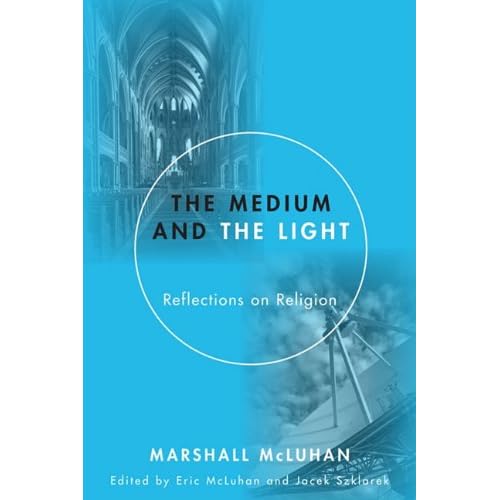
The Medium and the Light
Strange is the blindness of the intellect which does not consider that which it sees before all others and without which it can recognize nothing. But just as the eye, intent on the various differences of color, does not see the light through which it sees other things, or if it does see, does not notice it, so our mind's eye, intent on particular and universal beings, does not notice that being which is beyond all categories, even though it comes first to the mind, and through it, all other things.
St. Bonaventure
Itinerarium Mentis in Deum
Thursday, August 18, 2011
Why Bother With Marshall McLuhan?
Check out Alan Jacobs interesting and valuable meditation on the value (or lack thereof) in reading McLuhan:
"I have been reading McLuhan off and on since, at age sixteen, I bought a copy of The Gutenberg Galaxy. His centenary — McLuhan was born in Edmonton, Alberta on July 21, 1911 — provides an occasion for me to clarify my own oscillating responses to his work and his reputation. I have come to certain conclusions. First, that McLuhan never made arguments, only assertions. Second, that those assertions are usually wrong, and when they are not wrong they are highly debatable. Third, that McLuhan had an uncanny instinct for reading and quoting scholarly books that would become field-defining classics. Fourth, that McLuhan’s determination to bring the vast resources of humanistic scholarship to bear upon the analysis of new media is an astonishingly fruitful one, and an example to be followed. And finally, that once one has absorbed that example there is no need to read anything that McLuhan ever wrote."
http://www.thenewatlantis.com/publications/why-bother-with-marshall-mcluhan
"I have been reading McLuhan off and on since, at age sixteen, I bought a copy of The Gutenberg Galaxy. His centenary — McLuhan was born in Edmonton, Alberta on July 21, 1911 — provides an occasion for me to clarify my own oscillating responses to his work and his reputation. I have come to certain conclusions. First, that McLuhan never made arguments, only assertions. Second, that those assertions are usually wrong, and when they are not wrong they are highly debatable. Third, that McLuhan had an uncanny instinct for reading and quoting scholarly books that would become field-defining classics. Fourth, that McLuhan’s determination to bring the vast resources of humanistic scholarship to bear upon the analysis of new media is an astonishingly fruitful one, and an example to be followed. And finally, that once one has absorbed that example there is no need to read anything that McLuhan ever wrote."
http://www.thenewatlantis.com/publications/why-bother-with-marshall-mcluhan
Monday, May 30, 2011
McLuhan and the Eyes of Faith
![]() |
I wouldn't have seen it if I hadn't believed it. Marshall McLuhan |
You Know Nothing of My Work!
2009
Friday, March 4, 2011
The Answer of St. Thomas
When we are confronted by the bold fraud dreamt up by men whose confusion and spiritual frustration is the fruit of Satanic pride, the truth that is in us is made alive and lancing; but when a triumphant technology croons the sickly boasts of the advertising men, when the great vaults and vistas of the human soul are obscured by images of silken glamor, and when it is plain that man lives not by bread alone but by toothpaste also, then we need the answer of St. Thomas. It is the answer of moral and intellectual discipline and ardor.
Marshall McLuhan,
"Education of Free Men in Democracy,"
in St. Louis University Studies in Honor of St. Thomas Aquinas,
1943
Thursday, February 24, 2011
Ends and Education
Every person is by nature capable of determining his or her aims. Anyone who treats a person as the means to an end does violence to the very essence of the other, to what constitutes its natural right. Obviously, we must demand from a person, as a thinking individual, that his or her ends should be genuinely good, since the pursuit of evil ends is contrary to the rational nature of the person. This is also the purpose of education, both the education of children, and the mutual education of adults; it is just that -- a matter of seeking true ends, i.e. real goods as the ends of our actions, and of finding and showing to others the ways to realize them.
Karol Wojtyla, Love and Responsibility, 1981
Tuesday, January 25, 2011
Truth, Proclamation, and Authenticity of Life in the Digital Age
![]() |
| St. Francis de Sales |
Here are some highlights:
In the digital world, transmitting information increasingly means making it known within a social network where knowledge is shared in the context of personal exchanges. The clear distinction between the producer and consumer of information is relativized and communication appears not only as an exchange of data, but also as a form of sharing. This dynamic has contributed to a new appreciation of communication itself, which is seen first of all as dialogue, exchange, solidarity and the creation of positive relations. On the other hand, this is contrasted with the limits typical of digital communication: the one-sidedness of the interaction, the tendency to communicate only some parts of one's interior world, the risk of constructing a false image of oneself, which can become a form of self-indulgence.
Young people in particular are experiencing this change in communication, with all the anxieties, challenges and creativity typical of those open with enthusiasm and curiosity to new experiences in life. Their ever greater involvement in the public digital forum, created by the so-called social networks, helps to establish new forms of interpersonal relations, influences self-awareness and therefore inevitably poses questions not only of how to act properly, but also about the authenticity of one's own being. Entering cyberspace can be a sign of an authentic search for personal encounters with others, provided that attention is paid to avoiding dangers such as enclosing oneself in a sort of parallel existence, or excessive exposure to the virtual world. In the search for sharing, for "friends", there is the challenge to be authentic and faithful, and not give in to the illusion of constructing an artificial public profile for oneself.
For the full message, see catholic.org.
Via: Read Schuchardt, metaphilm.com
Tuesday, January 18, 2011
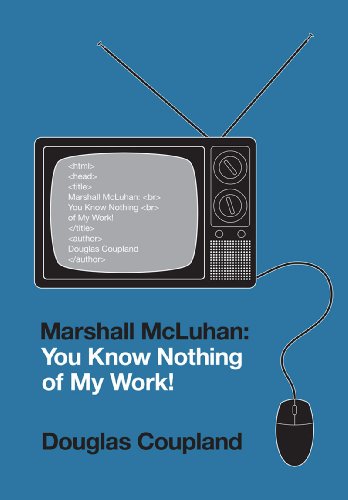
You Know Nothing of My Work!
Check out this excerpt from Nicholas Carr's review of You Know Nothing of My Work!, Douglas Coupland's new biography of McLuhan:
Neither his fans nor his foes saw him clearly. The central fact of McLuhan's life, as Coupland makes clear, was his conversion, at the age of twenty-five, to Catholicism, and his subsequent devotion to the religion’s rituals and tenets. Though he never discussed it, his faith forms the moral and intellectual backdrop to all his mature work. What lay in store, McLuhan believed, was the timelessness of eternity. The earthly conceptions of past, present, and future were, by comparison, of little consequence. His role as a thinker was not to celebrate or denigrate the world but simply to understand it, to recognize the patterns that would unlock history’s secrets and thus provide hints of God’s design. His job was not dissimilar, as he saw it, from that of the artist.
Click here for the rest of Carr's article
and here to buy the book on Amazon.
Thursday, October 28, 2010
Entering Through the Back Door
Here is a fragment of an interview with Marshall McLuhan by Nina Sutton in 1975, in which they discuss his conversion to Catholicism. Enjoy!
This clip is made available by the Library and Archives of Canada at the following link:
via: Read Schuchardt
Saturday, October 16, 2010
History
Monday, September 20, 2010
The Dark Night of the Soul
You're bored? That's because you keep your senses awake and your soul asleep.
-- St. Josemaría Escrivá, The Way, 1939
Via: Ruth Miller
Via: Ruth Miller
Monday, September 6, 2010
Catholicism and Protestantism in the Global Village
For the Catholic, the revealed Word of God is not the Gutenberg Bible, not the King James Version. But the Protestant cannot but take a different view of the passing of preeminence of the printed book, because Protestantism was born with the printing press and seems to be passing with it. There again, the Catholic alone has nothing to fear from the rapidity of the changes in the media of communication. But national cultures have much to fear. In fact, it is hard to see how any national culture as such can long stand up to the new media of communication. ... It is not markets we now invade but the cultures and the minds of men. And this process is furthest advanced here in North America.
Marshall McLuhan, The Medium and the Light,
from a lecture delivered at St. Joseph's College,
West Hartford, CT, 1954
from a lecture delivered at St. Joseph's College,
West Hartford, CT, 1954
Wednesday, August 25, 2010
A Conspiracy for Truth
The Catholic Monitor blog recently featured an older interview with Fr. John Hardon. It is a worthy read, but of particular interest is the following:
via: Dr. Read Schuchardt
Read the rest of the interview to see what else he has to say about media and martyrdom in our age.Well, on that day when my confessor and I were in conversation, Father Mole showed me the letter which he had just received from McLuhan, and in the postscript of that letter McLuhan wrote this statement, "The modern media are engaged in a Luciferian conspiracy against the truth." Certain statements you never forget. And that was prophetic. Since I've been with the Holy See, from Pope Paul VI to the present pope, John Paul II, the popes have wanted Catholics to change that. Imagine the alternative: "The modern media are engaged in a Christlike, shall I use the word, conspiracy, for the truth."
via: Dr. Read Schuchardt
Sunday, August 22, 2010
Media and Magisterium
The conditions attending the exercises of the magisterium of the Church in the twentieth century are such as to present an analogue with the first decade of the Christian Church. There is, on the one hand, the immediacy of interrelationship among Christians and non-Christians alike in a world where information moves at the speed of light. The populations of the world now co-exists in an extremely small space and in an instant of time. So far as the magisterium is concerned, it is as if the entire population of the world were present in a small room where perpetual dialogue was possible.
Marshall McLuhan, The Medium and the Light, 1973
Wednesday, August 18, 2010
The Patron Saint of TV
Did you know that TV has a patron saint? St. Clare, companion of St. Francis of Assissi and the foundress of the Poor Clares, is the patron of television. Why? Be enlightened by this video:
Sunday, August 8, 2010
The Lonely Parish
The following says more about airplanes than parish life, but it certainly does raise questions about the nature of parish community:
In Canada, the old parishes depended on horse and buggy to bring in the neighbouring farmers. Then suddenly the car appeared, and yesterday's communities disappeared because people no longer came together long enough to get to know each other. What sort of parish did that create? Made up of individuals who didn't know each other? Little by little we became like strangers at an airport waiting for the same airplane. And once in the airplane, we tended not to talk to our fellow passengers. To separate us better, we were supplied with headsets which, instead, put us in touch with the rest of humanity.
Marshall McLuhan, interview w/ Pierre Babin, The Medium and the Light, 1977
Sunday, August 1, 2010
Marshall McLuhan: Enemy of Society or Intellectual Thug?
![]() |
| Source |
I’ve already mentioned the recent post over at The Heresy Hunter, naming Marshall McLuhan an enemy of society, a “mass media mystifier,” and a Gnostic. The author of the hefty post, TH2, draws from a wide selection of McLuhan’s work, but unfortunately arrives at the conclusion that Marshall McLuhan is who all the techno-savvy people think he is: a technological prophet who foresaw and embraced a future, post-singularity world.
Most problematic in TH2’s analysis of McLuhan is his misunderstanding of several of McLuhan’s key ideas, especially “the medium is the message.” TH2 sees McLuhan’s (in)famous aphorism as an epistemological fallacy:
Note here that McLuhan's equalization of information with the commodity intimated his famous dictum "the medium is the message", i.e. medium = message, commodity = information or, philosophically abstracted, the thing is equal to the sign which represents that thing. The "medium" belongs to objective reality, and the "message" is the formal signification of that medium. Yet if a thing is made equivalent to a sign that represents that thing, all kinds of quandaries emerge in the area of epistemology. If the sign represented to the mind cannot be differentiated from thing in the world, if the message is not seen as really distinct from the physical medium, this would make understanding impossible. The distinction between the intelligible and sensible, the mind and the world, therefore become blurred, fused into one unit so to speak.
Yet this is not at all McLuhan’s goal. In saying “the medium is the message,” McLuhan hoped to shift the focus within the realm of media studies from the content of media to the media themselves. What is significant about watching television isn’t whether you are watching The Real World, Hannity & Colmes, or Monday night football, it is how the television affects what you are doing, how you think, and the social relationships between people. Thus, McLuhan said that “the content of a medium is like the juicy piece of meat carried by the burglar to distract the watchdog of the mind.” We often ignore the medium itself as we investigate the content.
To explain why the medium is the message, McLuhan’s favorite illustration was the electric light:
The electric light escapes attention as a communication medium just because it can have no 'content'. And this makes it an invaluable instance of how people fail to study media at all. For it is not till the electric light is used to spell out some brand name that it is notices as a medium. Then it is not the light but the 'content' (or what is really another medium) that is noticed. (Understanding Media)
Unfortunately, TH2 misunderstands McLuhan again:
If "electric light" has no "content", if it is not substantial, then what is it? If it is not something that can be perceived (whether biologically or with some technical instrumentation), what is it? It cannot be something and nothing at the same time, as this is in defiance of the principle of contradiction.
McLuhan uses the word “content” in the common understanding: something contained within something else. In the context of media studies, the word refers to the information or subject matter contained within a medium. For television it is a television show; for the Internet, a website; for the telephone, a conversation; et cetera. McLuhan used the example of the electric light because it has no content in the traditional sense. This allowed McLuhan to show just how much influence the medium itself can have, without considering the content.
Further, his example of the electric light demonstrates his broad understanding of technology as “extensions of our physical and nervous systems to increase power and speed.” TH2 seems to think that McLuhan “did not see a real distinction between man and his technological ‘extensions,’” for which he accuses him of ascribing mysterious qualities to technology (“a sure sign of Gnosticism”). Yet is this really mystifying? It is somewhat obvious that our tools increase the power and speed of some activity performed by our natural body (i.e. consider a shovel as an extension of your hand). Why does this become mystifying when applied to electric technology?
One particularly mystifying aspect that TH2 points out is McLuhan’s concept of the ‘global village,’ which he compares to the idea of monopsychism found in the work of Islamic philosopher Averroes. McLuhan:
Rapidly, we approach the final phase of the extensions of man—the technological simulation of consciousness, when the creative process of knowing will be collectively and corporately extended to the whole of human society, much as we have already extended our senses and our nerves by the various media. (Understanding Media)
The difference between electric technology and all previous technology for McLuhan is that where as non-electric technology extended our physical bodies, electric technology extends our consciousness. In fact, he went as far to say that computer technology was our externalized centralized nervous system. Many like to point to the combination of the Internet and the computer as embodying this exact notion (consider Wikipedia and IBM’s Watson). The Internet is a huge store of human knowledge, collectively developed and available to many. This is not really a mystical explanation. Though the technology that allows me to write this and you to read it would seem magical to anyone not born in the last century, it is old hat to us. McLuhan’s writing helps us to step back and consider our technology for how strange they really are.
Further, when you consider McLuhan’s more personal and religious writing (and interviews), it is clear that he was not the techno-prophet the singularity-types would like to make him:
Electric information environments being utterly ethereal fosters the illusion of the world as a spiritual substance. It is now a reasonable facsimile of the mystical body, a blatant manifestation of the Anti-Christ. After all, the Prince of this World is a very great electric engineer. (The Medium and the Light, 72)
In fact, McLuhan undertook the study of media not because he wished to mystify the new electric technology, but because he thought that if we could understand our older media and the principles by which they operate, then “we could reduce or even eliminate the electric factor from our lives.” (Understanding Media, 131)
This deals with TH2’s main contention with McLuhan: “his prioritization of sensation and negation of linear/logical thought/understanding.” McLuhan saw linear thought, visual space, and individualism as functions of the phonetic alphabet and the printing press. With the introduction of the telegraph and the rest of the electric media, McLuhan saw us returning to an acoustic concept of space and tribal involvement with each other, so that individualism “has been scrubbed right off our culture.” He saw this change as problematic:
Christianity definitely supports the idea of a private, independent metaphysical substance of the self. Where the technologies supply no cultural basis for this individual, then Christianity is in for trouble. (The Medium and the Light, 85)
Though McLuhan’s work often focused on electric technology, his body of work, especially his letters and interviews, reveal that not only was he wary of electric technologies and the changes that they would bring to linear thought and the private individual, but through his study hoped to better our cultural education and provide a “civil defense against media fallout.”
Initially, his work is hard to understand, but given time and patience McLuhan provides a helpful framework for encountering our mediated society. Is he an enemy of society? I think not.
Monday, July 26, 2010
The Heresy Hunter Hunts McLuhan
![]() |
| The Heresy Hunter |
"McLuhan was unmindful to this because he, like Hume, wrote that "the effects of technology do not occur at the level of opinion or concepts" [the mind], but at the level of "sense ratios or patterns of perception" [the body].
If "electric light" has no "content", if it is not substantial, then what is it? If it is not something that can be perceived (whether biologically or with some technical instrumentation), what is it? It cannot be something and nothing at the same time, as this is in defiance of the principle of contradiction.
Moreover, McLuhan wrote that light and power "eliminate" time and space.[29] But do they really? No. They only lessen the scales of "time and space factors" involved. They do not completely remove, effectuating an entire change in the character of technology. Rather, they noticeably reduce quantifiable magnitudes in a biological-sensorial sense.
As is now being evidenced, all kinds of fallacies are coming to the fore. This is simply because McLuhan presumed the medium to be equal to the message. When one really ponders the phrase "the medium is the message", it is classic Humeanism. The messages that man relays around the world are in themselves irretrievably tied in with the physical/technological contraption utilized to emit these messages or information, be it via satellite, television, radio, fax machine, internet, and so forth. The message, represented by universal signs, are fashioned to be equivalent to the medium, which is a singular thing or device. Information (in the forms of language, alphanumeric codes, graphical images, and so on) then become, not representations of commodities (things); instead, they are converted into commodities as such. To McLuhan there was, à la Hume, no distinction between the sensible and intelligible. The signs that communicate ideas to the mind, and the thing in the world as a really distinct existential unit from the mind, were not deemed as such by Marshall McLuhan. Again: he made understanding equivalent to technologically heightened sensation.
Thus TH2 [author of the post] concludes that Marshall McLuhan was a gnostic who mystified mass media. This is straightforwardly confirmed with the following:
The main obstacle to a clear understanding of the effects of the new media is our deeply embedded habit of regarding all phenomena from a fixed point of view.[82]
As with any gnostic, ancient or modern, philosopher or scientist, the remission of specificity or "a fixed point of view" is an error betraying a propensity towards relativism, leading inescapingly to obscurantism. "My response will follow, soon.
Subscribe to:
Posts (Atom)