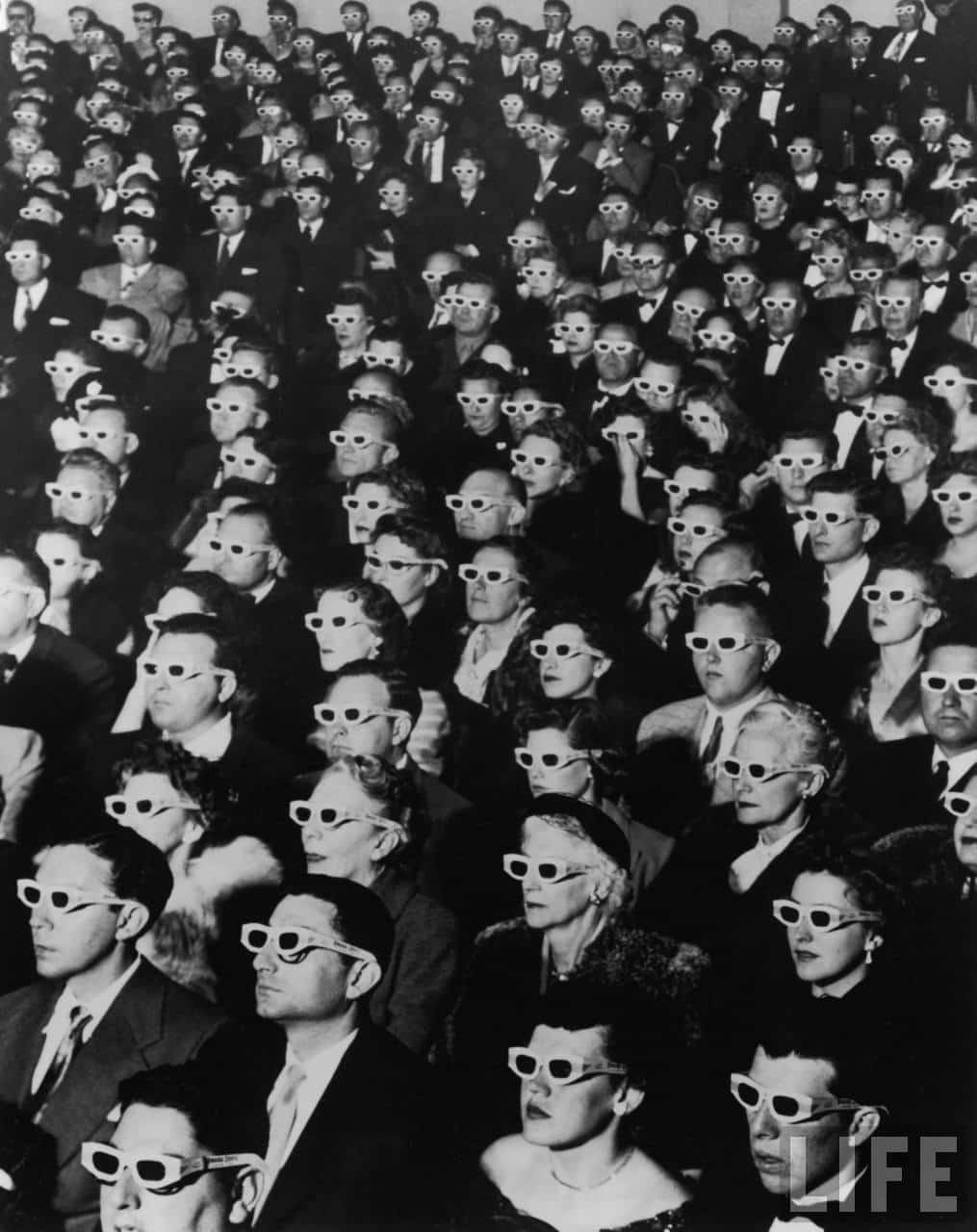
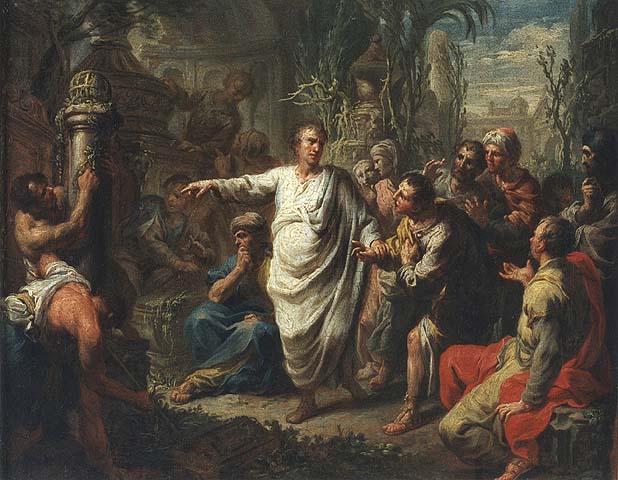
What do we really mean when we call something “spectacular"? Was Avatar spectacular because of the morals one might take from the story or because of the best special effects ever to be featured in a movie? The dictionary says that spectacular means “beautiful in a dramatic or eye-catching way,” and Avatar certainly was! Guy Debord, however, in his 1967 book The Society of the Spectacle, discusses what it really means for something to be spectacular, providing a much more penetrating significance. His incisive social critique surrounds what he sees as the defining characteristic of modern-day society: the spectacle. Similar to McLuhan’s focus on the transforming effects of media and Ellul’s all-encompassing view of the technological society, Debord’s spectacle reaches into all aspects of life and transforms them, acting as “a world view transformed into an objective force” (Debord 13). Debord’s concept of the spectacle is wide-ranging, and he explains how even in his time (before blogs, twitter, the internet, or even the personal computer) the spectacle has transformed society.
Debord’s definition of “spectacle” is peculiar, and he offers many definitions, corresponding to his use of the term as an all-encompassing descriptor of modern day society. Each definition contributes a new aspect or dimension of the spectacle’s existence, qualities, or transformative powers. The most general definition Debord offers we have already mentioned: the spectacle as a “world view transformed into an objective force (13). The world view provided by the spectacle finds its source in Western philosophy, the primary goal of which was “an attempt to understand activity by a means of the categories of vision” (17). As a result of the visual focus of the Enlightenment empiricists and other Western philosophy, modern society is now experiencing all the weaknesses of such an unbalanced understanding of the world.
This misunderstanding of reality has several implications for social relations, and social alienation is key to Debord’s understanding of the spectacle and society. For instance, “the spectacle is not a collection of images; rather it is a social relationship between people that is mediated by images” (12). The mediation of social relationships by the spectacle is a transformation of traditional social relations. As a result of the spectacle’s abundance within society, the world is divided into two parts: reality and the self-representation of reality, which becomes superior to reality (22). The spectacle then functions as “the common language that bridges this division” (22).
Imagine two families, one relaxing around a fire, the other relaxing around a TV. The first family, gathered around the fire, can talk about the fire, but for a more interesting conversation, they must draw from some other source; perhaps the story of the fish that got away or the bear that almost didn’t go away. The second family is provided the bridge of communication by the television. They might watch the fisherman on the Outdoor Channel catch a fish or watch a bear attack on the Discovery Channel, but their social relationship in this setting centers around the television and the stories it provides them. People often view watching television with others as a ‘communal’ act, and don’t mind the use of television unless it becomes isolating. Yet, Debord sees this kind of one-way relationship to each other via the screen as uniting what is separate, though “it unites only in its separateness” (22).
More than just screen technologies demonstrate the spectacle, as isolation underpins all technology: “all goods proposed by the spectacular system, from cars to televisions, also serve as weapons for that system as it strives to reinforce the isolation of the ‘lonely crowd’” (22). In short, the goal of the spectacular society is “to restructure society without community” (137). This is evident in many different realms, particularly social relations and economics. Much of Debord’s book is a neo-Marxist discussion of the present-day situation of the proletariat, revealing how social isolation via the spectacle has prevented the development of a proletariat class consciousness and an ensuing revolution (89). The overthrow of the society of the spectacle is thus directly related to the proletariat overcoming alienation and revolting against the isolation of technology in a disalienating way (154).
Nevertheless, technology pervades our society, and the rapid increases in technology we have witnessed even in the forty years since Debord’s book have only further ingrained the idea of the spectacle as “the bad dream of modern society in chains, expressing nothing more than its wish for sleep” (18). That the spectacle is the guardian of this sleep is evident within Maggie Jackson’s book Distracted: The Erosion of Attention and the Coming Dark Age. Certainly, her title is dramatic enough to compete with the intensity of Debord’s writing, and her writing reveals several phenomenon surrounding the topic of attention that reinforce Debord’s understanding of the spectacle.
A key idea within Jackson’s book that corresponds directly to Debord’s thesis is that “as the virtual shatters our conceptions of space and simultaneity redefines our notions of time, … a life of perpetual movement reshapes our relationship to place and what it means to be in the world” (Jackson 99). Jackson describes how our technologies have shaped us and our environment, and how this environment continues to reshape us. For instance, Jackson notes the very portable and mobile nature of modern-day Americans, quoting various statistics about dramatic increases in average annual number of miles driven and that “at any one time, three hundred thousand people are in flight above the United States” (101). The portability of our technology allows us the luxury of ‘staying in touch’ though we may be travelling across the world. Our social networking technology via the internet and other portable media devices certainly embody Debord’s understanding of isolation underpinning technology (22). Though we say we are staying in touch, touch is in fact completely unavailable via mediated communication.
Nonetheless, some maintain that virtual reality is still a form of reality, and Jackson documents the phenomenon wherein virtual reality is preferred to reality (66). This circumstance was obvious even forty years ago to Debord in his view of the division of the world into two parts: reality and self-representation (22). The young teenager preferring his video games to eating dinner with his family or the businessman preferring his Blackberry to his children both favor their particular virtual world because it is mediated via the spectacle. The teenager playing with his online friends and the businessman e-managing his coworkers are isolated not only from those around them but from those whom they are trying to communicate; they are united only in separateness (Debord 22).
Technology allows us to do more than just telecommunicate, it also allows us to “filter out noise, too-muchness, and others” (Jackson 65). Jackson gives the example of a DVD player in a minivan as a way for parents to ignore their children, and we see similar examples everyday: a wall of music via the iPod, the ability to ignore someone next to you in order to text someone across the room, and cell phone talkers at stores who are blissfully ignorant of anyone around them. What is the result of having so much ‘control’ over who we have to encounter? Jackson says that if we choose to filter out the actual world, “we become attentional wanderers, sated by the mirage” (67, see also Nicholas Carr’s new book, The Shallows). This is not necessarily the only result. Though a constant attunement to the distraction-making technologies that surround us certainly divides our attention, Debord’s assessment of the control that technology gives us is much more incisive: “the closer his life comes to being his own creation, the more drastically is he cut off from that life” (24). For both Debord and Jackson, there is something in the incontrollable, chance encounters in life that are more real and not to be avoided. In fact, these encounters seem to humanize people. Is there really something in a chance encounter that humanizes us, so that when we are caught off-guard we are really more ourselves?
Works Cited
Debord, Guy. The Society of the Spectacle. New York: Zone Books, 1995.
Jackson, Maggie. Distracted: The Erosion of Attention and the Coming Dark Age. Amherst, NY: Prometheus Books, 2009.