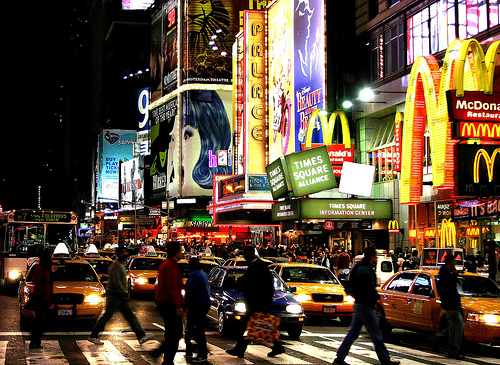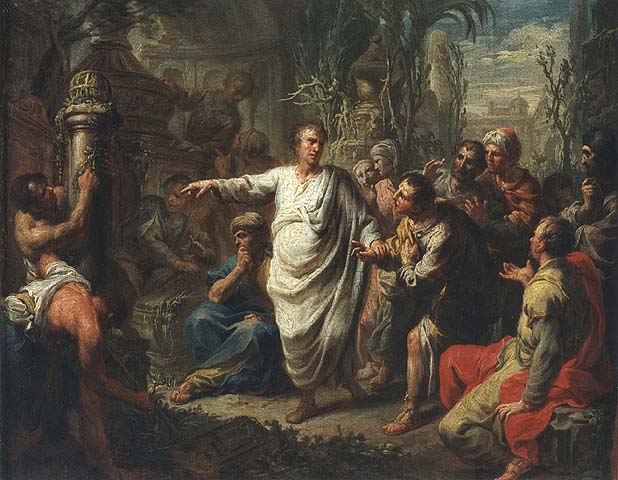
After the Second War, an ad-conscious American army officer in Italy noted with misgiving that Italians could tell you the names of cabinet ministers, but not the names of commodities preferred by Italian celebrities. Furthermore, he said, the wall space of Italian cities was given over to political, rather than commercial slogans. He predicted that there was small hope that Italians would ever achieve any sort of domestic prosperity or calm until they began to worry about the rival claims of cornflakes and cigarettes, rather than the capacities of public men. In fact, he went so far as to say that democratic freedom very largely consists in ignoring politics and worrying, instead, about the threat of scaly scalp, hairy legs, sluggish bowels, saggy breasts, receding gums, excess weight, and tired blood.
Marshall McLuhan
Understanding Media,
1964

Showing posts with label Advertising. Show all posts
Friday, September 9, 2011
Friday, March 4, 2011
The Answer of St. Thomas
When we are confronted by the bold fraud dreamt up by men whose confusion and spiritual frustration is the fruit of Satanic pride, the truth that is in us is made alive and lancing; but when a triumphant technology croons the sickly boasts of the advertising men, when the great vaults and vistas of the human soul are obscured by images of silken glamor, and when it is plain that man lives not by bread alone but by toothpaste also, then we need the answer of St. Thomas. It is the answer of moral and intellectual discipline and ardor.
Marshall McLuhan,
"Education of Free Men in Democracy,"
in St. Louis University Studies in Honor of St. Thomas Aquinas,
1943
Sunday, November 21, 2010
The Religious Literature of Commercials
"It's time for a phone to save us from our phones"
But the TV commercial does not present products in a form that calls upon analytic skills or what we customarily think of as rational and mature judgment. It is not facts that are offered to the consumer but idols, to which both adults and children can attach themselves with equal devotion and without the burden of logic or verification. It is, therefore, misleading even to call this form of communication "commercials," since they disdain the rhetoric of business and do their work largely with the symbols and rhetoric of religion. Indeed, I believe it is entirely fair to conclude that television commercials are a form of religious literature.
Neil Postman, The Disappearance of Childhood, 1982
Thursday, November 11, 2010
The Poetry of Life
Recently seen on the Media Ecology Association listserv:
They are giving out these for free over at http://burningbooksposters.blogspot.com/, or you can buy one of their other interesting posters.
via: Read Schuchardt
Wednesday, September 1, 2010
Man: An Instrument of Efficiency
Advertisers have been reading up on their media ecology this summer. Then, they turn it around and try to use it to get you to buy stuff. Jacques Ellul's biggest social critique was that technology (both hardware and software) was making us less human by making us servants to efficiency. Now that we live in the 21st century and have gotten past all that Luddite mumbo jumbo, we can switch these arguments around and use them to sell stuff. Buy a Droid: because your goal in life is to be "an instrument of efficiency."
Peep this:
via: Nicholas Oswald
Peep this:
via: Nicholas Oswald
Sunday, August 29, 2010
The Things We Make, Make Us
Jeep's commercial, released earlier this summer, wants to convince you that media ecology is true. Why? So you'll buy a Jeep. Because "The things we make (read: buy), make us."
Thursday, July 29, 2010
Advertising and Automation
Many people have expressed uneasiness about the advertising enterprise in our time. To put the matter abruptly, the advertising industry is a crude attempt to extend the principles of automation to every aspect of society. Ideally, advertising aims at the goal of a programmed harmony among all human impulses and aspirations and endeavors. Using handicraft methods, it stretches out toward the ultimate electronic goal of a collective consciousness. When all production and all consumption are brought into a pre-established harmony with all desire and all effort, then advertising will have liquidated itself by its own success.
-- Marshall McLuhan, Understanding Media, 1964
Saturday, July 3, 2010
A Place to Stand
-- Marshall McLuhan, 1964Archimedes once said, “Give me a place to stand and I will move the world.” Today he would have pointed to our electric media and said, “I will stand on your eyes, your ears, your nerves, and your brain, and the world will move in any tempo or pattern I choose.” We have leased these "places to stand" to private corporations.
Subscribe to:
Posts (Atom)