Thursday, October 20, 2011

McLuhan's Three Books

With our accelerating cascade of new media it is borne upon us that each represents not an appendix to but a complete retranslation of the Book of the World, and of the reader. As W.B. Yeats sang, in 'Sailing to Byzantium': 


Once out of nature I shall never take
My bodily form from any natural thing,
But such a form as Grecian goldsmiths make
Of hammered gold and gold enamelling...
Vico simply had not distinguished between first and second nature for separate study: nothing in his experience suggested such a distinction would be of any use. Second nature is nature made and remade by man as man remakes himself with his extensions. Separate them: the first is the province of traditional grammar; the second, that of Bacon, Vico, and Laws of Media.


Eric and Marshall McLuhan
Laws of Media 


Wednesday, October 19, 2011

Liberty, Technology, and the Advent of Social Networking

St. Michael the Boss
Interesting article by  Harvad PhD candidate, Gladden J. Pappin, discussing the intersection of virtue, vice, and social media, with nods to McLuhan and Baudrillard. 


How does technology recast the relationship between liberty and virtue?


"To fashion our network double we have to resolve ourselves into our constituent parts, advance some and suppress others, make ourselves the medium without making our souls the message.


"The community of the Internet is now as spiritual as the communion of saints once was, so it is fitting that McLuhan thought Thomas Aquinas's angelology was important in understanding the media. Through social networking we receive not prayers and graces but links and likes. The church triumphant appears in virtual reality, where all things are possible and everything is realized virtually in the mystical body of the web. As in the resurrection of the body, logging off from your account gives you your body back, this time not glorified but fraught with anxiety, the church suffering after triumph rather than the reverse. Signed off from your account, you are now unaccounted-for. Reality itself becomes the afterlife, the postmodern No Exit where hell is virtual people. The advent of virtual reality, not to say the beginning of modern politics itself, detaches human beings from the consolations of church, city, and family that wayfarers in this life once thought they had. A late-modern Augustine could not see technology as just another dimension of alienation from our heavenly home. We are now aliens twice removed."

Wednesday, September 28, 2011

I've Never Seen Anything Like It!

Really, I haven't! The Fordham website for the Marshall McLuhan Centenary has posted the audio recording from a class McLuhan taught during his year at Fordham in 1967. Totally awesome!


Marshall McLuhan Lecturing at Fordham


Monday, September 19, 2011

Kill Your TV or it Might Kill You!

Is too much TV as dangerous as smoking? Check out this article on the Australian research.


"eve­ry hour of TV watched af­ter age 25 may slice about 22 min­utes off your life, an effect equi­val­ent to that of two cigarettes"


Saturday, September 17, 2011

Marshall McLuhan's Unmediated Faith

An interesting article on McLuhan's Catholicism, originally posted at the Catholic Herald, now reposted on Thirteen:


St. Basil's at University of Toronto

Wednesday, September 14, 2011

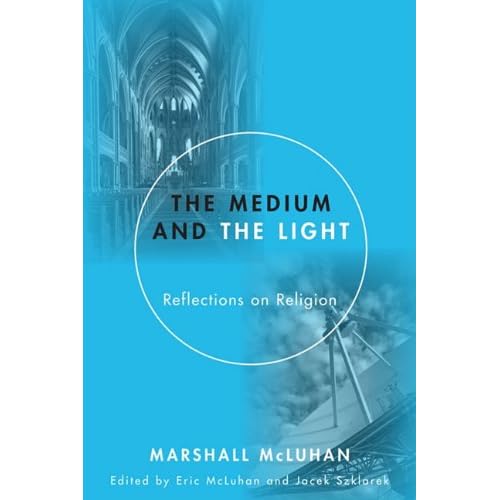
The Medium and the Light

Strange is the blindness of the intellect which does not consider that which it sees before all others and without which it can recognize nothing. But just as the eye, intent on the various differences of color, does not see the light through which it sees other things, or if it does see, does not notice it, so our mind's eye, intent on particular and universal beings, does not notice that being which is beyond all categories, even though it comes first to the mind, and through it, all other things.


St. Bonaventure
Itinerarium Mentis in Deum

Friday, September 9, 2011

The New Res Publica

After the Second War, an ad-conscious American army officer in Italy noted with misgiving that Italians could tell you the names of cabinet ministers, but not the names of commodities preferred by Italian celebrities. Furthermore, he said, the wall space of Italian cities was given over to political, rather than commercial slogans. He predicted that there was small hope that Italians would ever achieve any sort of domestic prosperity or calm until they began to worry about the rival claims of cornflakes and cigarettes, rather than the capacities of public men. In fact, he went so far as to say that democratic freedom very largely consists in ignoring politics and worrying, instead, about the threat of scaly scalp, hairy legs, sluggish bowels, saggy breasts, receding gums, excess weight, and tired blood.


Marshall McLuhan
Understanding Media,
1964