Showing posts with label Eric McLuhan. Show all posts

Thursday, October 20, 2011

McLuhan's Three Books

With our accelerating cascade of new media it is borne upon us that each represents not an appendix to but a complete retranslation of the Book of the World, and of the reader. As W.B. Yeats sang, in 'Sailing to Byzantium': 


Once out of nature I shall never take
My bodily form from any natural thing,
But such a form as Grecian goldsmiths make
Of hammered gold and gold enamelling...
Vico simply had not distinguished between first and second nature for separate study: nothing in his experience suggested such a distinction would be of any use. Second nature is nature made and remade by man as man remakes himself with his extensions. Separate them: the first is the province of traditional grammar; the second, that of Bacon, Vico, and Laws of Media.


Eric and Marshall McLuhan
Laws of Media 


Tuesday, June 7, 2011

Finding Your Way in a Sea of Information

The goal of science and the arts and of education for the next generation must be to decipher not the genetic but the perceptual code. In a global information environment, the old pattern of education in answer-finding is of no avail: one is surrounded by answers, millions of them, moving and mutating at electric speed. Survival and control will depend on the ability to probe and to question in the proper way and place. As the information that constitutes the environment is perpetually in flux, so the need is not for fixed concepts but rather for the ancient skill of reading that book, for navigating through an ever uncharted and unchartable milieu. Else we will have no more control of this technology and environment than we have of the wind and the tides.


Marshall and Eric McLuhan
Laws of Media,
1988

Saturday, April 2, 2011

The Joyce of McLuhan Studies

He [Marshall McLuhan] was never reticent about the debt he owed to Joyce in particular, and frequently uttered and published such statements as this: 'Nobody could pretend serious interest in my work who is not completely familiar with all the works of James Joyce and the French symbolists.' Such statements were intended to be taken quite literally: a full appreciation of McLuhan's work is impossible without the sort of perceptual training that such familiarity instils. ... He once remarked to me, as I know he did to many others, that his work on media and culture was, in the main, 'applied Joyce.'


Eric McLuhan, The Role of Thunder in Finnegans Wake, 1997

Tuesday, January 4, 2011

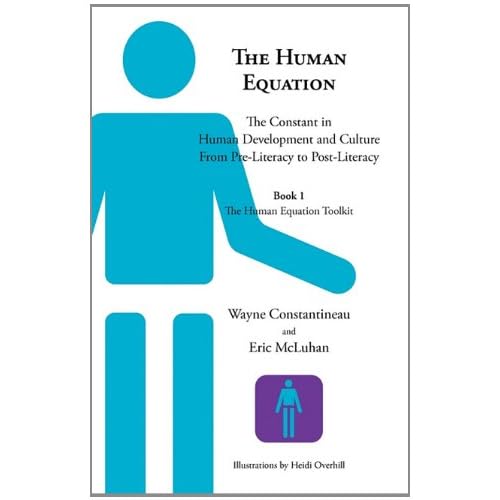
The Human Equation

From Eric McLuhan:
The Human Equation is out!
Here is the URL: It is offered through Amazon (or you can order directly from the publisher, BPS Books).

The Human Equation is a completely new and different approach to the study of media and technologies. It does not rely on any previous theory of media or school of understandings about them. No technical expertise is necessary.

We begin with the announcement, in Understanding Media: The Extensions of Man, that all media and technologies have their origins as extensions of the user's body and faculties, The Human Equation examines the process of extending and the various modes of innovation that are possible in each area of technology, given the human body's repertoire of actions and postures. Now, on the centenary of Marshall McLuhan's birth, we have reinvented the study of media in the direction that he pointed to in that seminal work, Understanding Media.

Since this book is being published over the Internet, we have to rely on personal recommendations to get the word out, so please share this with friends and any you know who might be able to use this new approach to media. 

Saturday, September 25, 2010

Eric McLuhan @ Pattern Recognition

Read Schuchardt has posted a transcript of Eric McLuhan's Wheaton College presentation from several weeks ago. Even if you've heard the talk, it's worth the read.


http://trueslant.com/readschuchardt/2010/09/24/a-wee-sip-from-the-fire-hose/

Thursday, September 16, 2010

On Two Natures

Aristotle first noted that the Greek invention of Nature was made possible when they had left behind a savage or barbaric state (first nature) by putting on an individualized and civilized one (second nature). And A.T.W. Simeons has discussed at length how disruptive the second nature has been to the first. Made discarnate by our electric information media, the west is furiously at work retrieving its obsolesced organic first nature in a spectrum of new aesthetic modes, from feminism to phenomenology. As our second nature consists entirely in our artifacts and extensions and the grounds and narcoses they impose, their etymologies are all to be found in first nature, the wild body.


Marshall and Eric McLuhan, Laws of Media, 1988

Saturday, September 4, 2010

The McLuhan's at Wheaton College

This week at Wheaton College my peers and I had the delightful privilege of hosting Eric and Andrew McLuhan. They were quite gracious with their time, and we greatly enjoyed their company. Apart from hanging out and talking media ecology (and Catholicism), Eric participated in a roundtable discussion on the greatest moral challenges of the next decade, discussing the transformations caused by electric technology. A recording of the roundtable can be streamed or downloaded here:

- Presentation (Eric's is the second presentation)

- Discussion

Check them out, and enjoy the discussion. 

----

Bonus! Let me share with you a nugget which Andrew shared with me. Again, a big thanks to you both!

The Guy:


via: Andrew McLuhan and WETN

Sunday, July 25, 2010

Discarnate Man is Not Compatible with an Incarnate Church

When people are on the telephone or on the air, they have no physical bodies but are translated into abstract images. Their old physical beings are entirely irrelevant to the new situations. The discarnate user of electric media bypasses all former spatial restrictions and is present in many places simultaneously as a disembodied intelligence. This puts him one step above angels, who can only be in one place at a time. Since, however, discarnate man has no relation to natural law (or to Western lineality), his impulse is towards anarchy and lawlessness. Minus his body, the user of telephone or radio or TV is also minus his private identity, an effect that is becoming increasingly relevant.


-- Marshall and Eric McLuhan, Laws of Media, 1988