Showing posts with label James Joyce. Show all posts

Thursday, August 18, 2011

Why Bother With Marshall McLuhan?

Check out Alan Jacobs interesting and valuable meditation on the value (or lack thereof) in reading McLuhan:

"I have been reading McLuhan off and on since, at age sixteen, I bought a copy of The Gutenberg Galaxy. His centenary — McLuhan was born in Edmonton, Alberta on July 21, 1911 — provides an occasion for me to clarify my own oscillating responses to his work and his reputation. I have come to certain conclusions. First, that McLuhan never made arguments, only assertions. Second, that those assertions are usually wrong, and when they are not wrong they are highly debatable. Third, that McLuhan had an uncanny instinct for reading and quoting scholarly books that would become field-defining classics. Fourth, that McLuhan’s determination to bring the vast resources of humanistic scholarship to bear upon the analysis of new media is an astonishingly fruitful one, and an example to be followed. And finally, that once one has absorbed that example there is no need to read anything that McLuhan ever wrote."


http://www.thenewatlantis.com/publications/why-bother-with-marshall-mcluhan

Saturday, May 28, 2011

Splitting the Etym

The "etym" is the fundamental 'bit' in the Joycean world, just as the atom is in the physical world. For Joyce, TV's annihilating of the 'etym' is as significant as in the realm of culture as the potentiality of destroying the atom in the physical world. Since, however, neither etym nor atom disappears as a result of the contemporary challenge, the process is abnihilisation, not actually a destruction.

Donald Theall
Beyond the Word,
1998

Thursday, April 21, 2011

The Self Mover: Automobile
Source
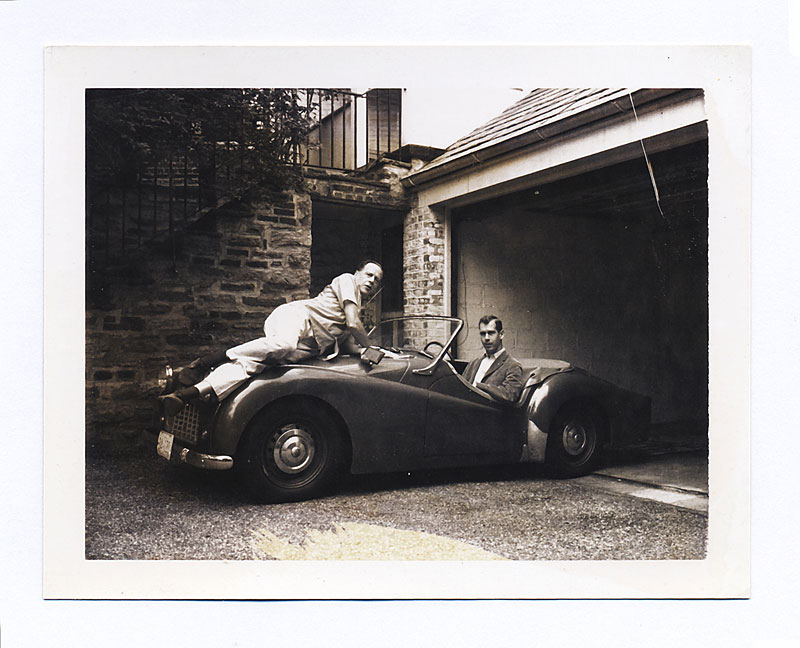
In the spring of 1928 when the Swiss art historian Carola Giedion-Welcker first visited James at his flat in Paris, their conversation included a highly suggestive interchange about technology. She reports that Joyce asked, "Tell me what sort of an idea do you think the word 'automobile' would have aroused in the middle ages," and without waiting for a reply, he continued, "Certainly only that of a divine being, a self mover, thus a god." ... Recollecting that original conversation, she observes that there is a cultural project central to the Wake by which, "from a key word and the conceptions it aroused, Joyce wanted to crystalize a cultural state, or better yet the cultural crisis of a century. For god and technology had moved critically close to each other.


Donald Theall, James Joyce's Techno-Poetics, 1997

Monday, April 18, 2011

The Medium is the Message
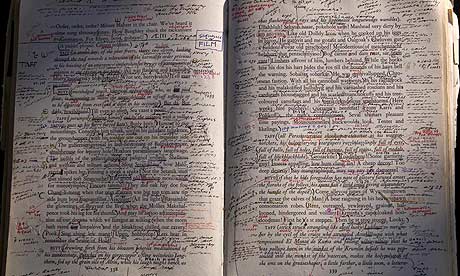
On turning to the 'Work in Progress' [Finnegans Wake] we find that the mirror is not so convex. Here is direct expression--pages and pages of it. And if you don't understand it, Ladies and Gentlemen, it is because you are too decadent to receive it. You are not satisfied unless the form is so strictly divorced from the content that you can comprehend the one almost without bothering to read the other. ... Here form is content, content is form. You complain that this stuff is not written in English. It is not written at all. It is not to be read--or rather it is not only to be read. It is to be looked at and listened to. His writing is not about something; it is that something itself.


Samuel Beckett, "Dante... Bruno. Vico.. Joyce,"
in Our Exagmination Round His Factification
For Incamination of Work in Progress, 1929

Saturday, April 16, 2011

Beyond Media

In the 1960s Marshall McLuhan came to be for the populace the prophet of the death of the book, since many commentators transformed his observations on these problems into an unqualified prediction and endorsement of that death. What actually has been implied as taking place in this process is not the movement beyond a particular medium, such as the book or print, but a movement beyond the very idea of a unique communication medium. The appearance of new methods of technological production, reproduction, and distribution permitted the possibility of transcending traditionally recognized modes and returning to the original vision of the poetic as a concept which could simultaneously embrace various modes of communication, as in Aristotle's treatment of drama in the Poetics. Joyce represents a monumental movement beyond media--itself a comic commentary on McLuhan and his commentators.


Don Theall, Beyond the Word, 1995

Saturday, April 2, 2011

The Joyce of McLuhan Studies

He [Marshall McLuhan] was never reticent about the debt he owed to Joyce in particular, and frequently uttered and published such statements as this: 'Nobody could pretend serious interest in my work who is not completely familiar with all the works of James Joyce and the French symbolists.' Such statements were intended to be taken quite literally: a full appreciation of McLuhan's work is impossible without the sort of perceptual training that such familiarity instils. ... He once remarked to me, as I know he did to many others, that his work on media and culture was, in the main, 'applied Joyce.'


Eric McLuhan, The Role of Thunder in Finnegans Wake, 1997