Showing posts with label Books. Show all posts

Friday, April 29, 2011

The Perpetual Nomad

All this information and more has overtly, osmotically, or perhaps inadvertently damaged a collective sense of time that has been working well enough since the Industrial Revolution and the rise of the middle classes. This "timesickness" is probably what killed the economy, and God only knows what it's up to next. Everywhere we look, people are making online links--to conspiracy, porn, and gossip sites; to medical data sites and genetics sites; to baseball sites and sites for Fiestaware collectors; to sites where they can access free movies and free TV, arrange hookups with old flames or taunt old enemies--and time has begun to erase the twentieth century way of structuring one's day and locating one's sense of community. People are now doing their deepest thinking and making their most emotionally charged connections with people around the planet at all times of the day. Geography has become irrelevant. Our online phantom world has become the new us. We create complex webs of information and people who support us, and yet they are fleeting, so tenuous. Time speeds up and then it begins to shrink. Years pass by in minutes. Life becomes that strange experience in which you're zooming along a freeway and suddenly realize that you haven't paid any attention to driving for the last fifteen minutes, yet you're still alive and didn't crash. The voice inside your head has become a different voice. It used to be "you." Now your voice is that of a perpetual nomad drifting along a melting landscape, living day to day, expecting everything and nothing.


Douglas Coupland, Marshall McLuhan: 
You Know Nothing of My Work!
2009

Monday, April 18, 2011

The Medium is the Message

On turning to the 'Work in Progress' [Finnegans Wake] we find that the mirror is not so convex. Here is direct expression--pages and pages of it. And if you don't understand it, Ladies and Gentlemen, it is because you are too decadent to receive it. You are not satisfied unless the form is so strictly divorced from the content that you can comprehend the one almost without bothering to read the other. ... Here form is content, content is form. You complain that this stuff is not written in English. It is not written at all. It is not to be read--or rather it is not only to be read. It is to be looked at and listened to. His writing is not about something; it is that something itself.


Samuel Beckett, "Dante... Bruno. Vico.. Joyce,"
in Our Exagmination Round His Factification
For Incamination of Work in Progress, 1929

Sunday, April 10, 2011

The Limits of Knowledge

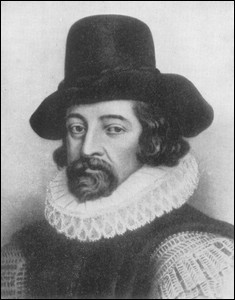
To conclude therefore, let no man upon a weak conceit of sobriety or an ill-applied moderation think or maintain, that a man can search too far, or be too well studied in the book of God's word, or in the book of God's works; divinity or philosophy: but rather let men endeavour an endless progress or proficience in both; only let men beware that they apply both to charity, and not to swelling; to use, and not to ostentation; and again, that they do not unwisely mingle or confound these learnings together.


Francis Bacon, Advancement of Learning, 1605

Saturday, April 2, 2011

The Joyce of McLuhan Studies

He [Marshall McLuhan] was never reticent about the debt he owed to Joyce in particular, and frequently uttered and published such statements as this: 'Nobody could pretend serious interest in my work who is not completely familiar with all the works of James Joyce and the French symbolists.' Such statements were intended to be taken quite literally: a full appreciation of McLuhan's work is impossible without the sort of perceptual training that such familiarity instils. ... He once remarked to me, as I know he did to many others, that his work on media and culture was, in the main, 'applied Joyce.'


Eric McLuhan, The Role of Thunder in Finnegans Wake, 1997

Tuesday, January 18, 2011

You Know Nothing of My Work!

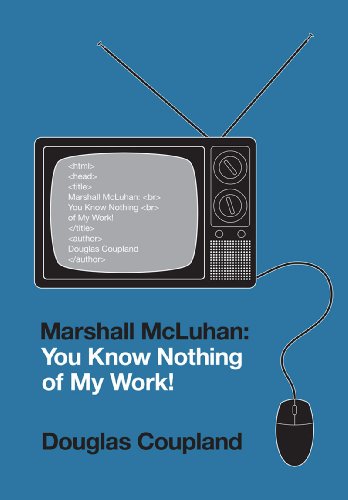
Check out this excerpt from Nicholas Carr's review of You Know Nothing of My Work!, Douglas Coupland's new biography of McLuhan:


Neither his fans nor his foes saw him clearly. The central fact of McLuhan's life, as Coupland makes clear, was his conversion, at the age of twenty-five, to Catholicism, and his subsequent devotion to the religion’s rituals and tenets. Though he never discussed it, his faith forms the moral and intellectual backdrop to all his mature work. What lay in store, McLuhan believed, was the timelessness of eternity. The earthly conceptions of past, present, and future were, by comparison, of little consequence. His role as a thinker was not to celebrate or denigrate the world but simply to understand it, to recognize the patterns that would unlock history’s secrets and thus provide hints of God’s design. His job was not dissimilar, as he saw it, from that of the artist.


Click here for the rest of Carr's article
and here to buy the book on Amazon.

Tuesday, January 4, 2011

The Human Equation

From Eric McLuhan:
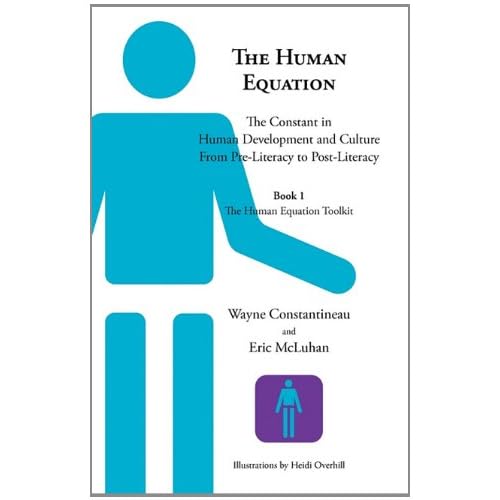
The Human Equation is out!
Here is the URL: It is offered through Amazon (or you can order directly from the publisher, BPS Books).

The Human Equation is a completely new and different approach to the study of media and technologies. It does not rely on any previous theory of media or school of understandings about them. No technical expertise is necessary.

We begin with the announcement, in Understanding Media: The Extensions of Man, that all media and technologies have their origins as extensions of the user's body and faculties, The Human Equation examines the process of extending and the various modes of innovation that are possible in each area of technology, given the human body's repertoire of actions and postures. Now, on the centenary of Marshall McLuhan's birth, we have reinvented the study of media in the direction that he pointed to in that seminal work, Understanding Media.

Since this book is being published over the Internet, we have to rely on personal recommendations to get the word out, so please share this with friends and any you know who might be able to use this new approach to media. 

Saturday, December 11, 2010

Reading in the Middle Ages

There are some of a dozen rules of a general character that Hugh [of St. Victor] gives for the shaping of those habits which the reader must acquire so that his striving lead him to wisdom, rather than to the accumulation of knowledge pursued for the purpose of showing off. The reader is one who has made himself into an exile in order to concentrate his entire attention and desire on wisdom, which thus becomes the hoped-for home.


Ivan Illich, In the Vineyard of the Text, 1996

Monday, October 18, 2010

On Writing and Reading

There are two kinds of writing:


A. Books a man reads to develop his capacities, in order to know more and perceive more, and more quickly, than he did before he read them.


B. Books that are intended and that serve as REPOSE, dope, opiates, mental beds.


--Ezra Pound, ABC of Reading, 1934