Saturday, January 22, 2011

Education and Entertainment

The Mechanical Bride
Few students ever acquire skill in analysis of newspapers. Fewer have any ability to discuss a movie intelligently. To be articulate and discriminating about ordinary affairs and information is the mark of an educated man. It's misleading to suppose there's any basic difference between education and entertainment. This distinction merely relieves people of the responsibility of looking into the matter. It's like setting up a distinction between didactic and lyric poetry on the ground that one teaches, the other pleases. However, it's always been true that whatever pleases teaches more effectively.


Marshall McLuhan, Classroom Without Walls,
Explorations in Communication, 1960

Wednesday, January 19, 2011

The End of Nature

A Beehive of Satellites
The information environment and effects created by the computer are as inaccessible to literate vision as the external world is to the blind. For example, the computer has made possible our satellites which have put a man-made environment around the planet, ending "nature" in the older sense. The new information technology will shortly encompass the entire astral system, harnessing its resources for terrestrial use. The important thing is to realize that electric information systems are live environments in the full organic sense. They alter our feelings and our sensibilities, especially when they are not attended to.


Marshall McLuhan, War and Peace in the Global Village, 1968

Tuesday, January 18, 2011

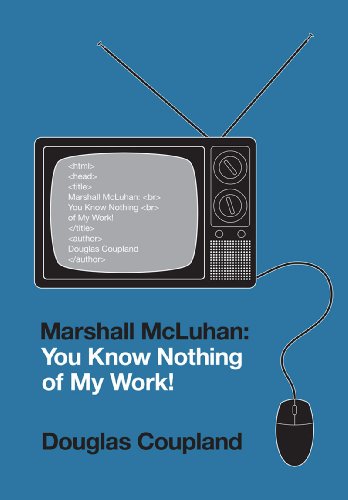
You Know Nothing of My Work!

Check out this excerpt from Nicholas Carr's review of You Know Nothing of My Work!, Douglas Coupland's new biography of McLuhan:


Neither his fans nor his foes saw him clearly. The central fact of McLuhan's life, as Coupland makes clear, was his conversion, at the age of twenty-five, to Catholicism, and his subsequent devotion to the religion’s rituals and tenets. Though he never discussed it, his faith forms the moral and intellectual backdrop to all his mature work. What lay in store, McLuhan believed, was the timelessness of eternity. The earthly conceptions of past, present, and future were, by comparison, of little consequence. His role as a thinker was not to celebrate or denigrate the world but simply to understand it, to recognize the patterns that would unlock history’s secrets and thus provide hints of God’s design. His job was not dissimilar, as he saw it, from that of the artist.


Click here for the rest of Carr's article
and here to buy the book on Amazon.

Monday, January 10, 2011

Discarnate Man and Natural Law

On the telephone, or on the air, man is in every sense discarnate, existing as an abstract image, a figure without a body. The Cheshire cat in Alice in Wonderland  is a kind of parallel to our state. When discarnate, man has no identity, and is not subject to natural law. In fact he has no basis for morals of any sort. As electric information moved at the speed of light, man is a nobody. When deprived of his identity, man becomes violent in divers ways. Violence is the quest for identity. In Canada there is pending a large body of nihilistic legislation dedicated to the ideal of freedom. No-fault divorce is being succeeded by no-fault murder!


Letter to Clare Boothe Luce, April 5, 1979, Letters of Marshall McLuhan

Friday, January 7, 2011

The Medium is the Message: Exercise in Gestalt Psychology

If you speak of the car as a medium, you are no further ahead because the car is no more than a figure detaching itself from a service environment of expressways, oil companies, automobile assembly lines, etc. The real medium, in the case of the car, is the totality of services it creates, or, better yet, the huge change that it creates in the human community. The car as the figure is not the message.


For North Americans, the hidden ground, the real message, of the car is what it does with our sense of privacy. The effect is different in Europe, but the car for us has been largely created to insure our privacy; in other words, the car's message is privacy, intimacy, and solitude. Privacy is made possible by the large network of highways, the biggest architectural structure in the history of the world which, by contrast, makes the pyramids and the Great Wall of China seem small. The car itself is no more than a figure in this service environment.


Marshall McLuhan, The Medium and the Light, Second Conversation with Pierre Babin, 1977

Tuesday, January 4, 2011

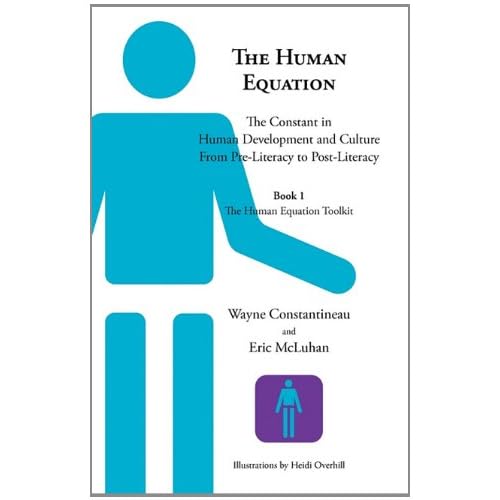
The Human Equation

From Eric McLuhan:
The Human Equation is out!
Here is the URL: It is offered through Amazon (or you can order directly from the publisher, BPS Books).

The Human Equation is a completely new and different approach to the study of media and technologies. It does not rely on any previous theory of media or school of understandings about them. No technical expertise is necessary.

We begin with the announcement, in Understanding Media: The Extensions of Man, that all media and technologies have their origins as extensions of the user's body and faculties, The Human Equation examines the process of extending and the various modes of innovation that are possible in each area of technology, given the human body's repertoire of actions and postures. Now, on the centenary of Marshall McLuhan's birth, we have reinvented the study of media in the direction that he pointed to in that seminal work, Understanding Media.

Since this book is being published over the Internet, we have to rely on personal recommendations to get the word out, so please share this with friends and any you know who might be able to use this new approach to media. 
Sunday, January 2, 2011

A Liberal Education

All liberal arts, in both the sciences and the humanities, are animated by the fundamental human desire to know, the fulfillment of which is a good, even if it provides no economic or political benefit whatsoever. An education for economic productivity and political utility alone is an education for slaves, but an education for finding, collecting and communicating reality is an education for free people, people free to know what is so. Remember, knowing the real is a good before it is a power.


Scott Crider, The Office of Assertion, 2005