Thursday, January 27, 2011

Thus Spoke Marshall McLuhan

Check this: 


A compilation of videos featuring none other than Marshall McLuhan.


www.marshallmcluhanspeaks.com


Go see and hear the man himself explain his sayings, prophecies, the electric age, television, and his own quirky methods!

Tuesday, January 25, 2011

Truth, Proclamation, and Authenticity of Life in the Digital Age

St. Francis de Sales
The Vatican released yesterday Pope Benedict XVI's message in preparation for the 45th World Communications Day on the occasion of the Feast Day of St. Francis de Sales, the patron saint of journalists. The message, entitled Truth, Proclamation, and Authenticity of Life in the Digital Age encourages the faithful--especially the youth--to thoughtfully examine their own participation in the digital environment for the purpose of effectively proclaiming the Gospel in all areas of life.


Here are some highlights:


In the digital world, transmitting information increasingly means making it known within a social network where knowledge is shared in the context of personal exchanges. The clear distinction between the producer and consumer of information is relativized and communication appears not only as an exchange of data, but also as a form of sharing. This dynamic has contributed to a new appreciation of communication itself, which is seen first of all as dialogue, exchange, solidarity and the creation of positive relations. On the other hand, this is contrasted with the limits typical of digital communication: the one-sidedness of the interaction, the tendency to communicate only some parts of one's interior world, the risk of constructing a false image of oneself, which can become a form of self-indulgence.

Young people in particular are experiencing this change in communication, with all the anxieties, challenges and creativity typical of those open with enthusiasm and curiosity to new experiences in life. Their ever greater involvement in the public digital forum, created by the so-called social networks, helps to establish new forms of interpersonal relations, influences self-awareness and therefore inevitably poses questions not only of how to act properly, but also about the authenticity of one's own being. Entering cyberspace can be a sign of an authentic search for personal encounters with others, provided that attention is paid to avoiding dangers such as enclosing oneself in a sort of parallel existence, or excessive exposure to the virtual world. In the search for sharing, for "friends", there is the challenge to be authentic and faithful, and not give in to the illusion of constructing an artificial public profile for oneself.


For the full message, see catholic.org.


Via: Read Schuchardt, metaphilm.com

Saturday, January 22, 2011

Education and Entertainment

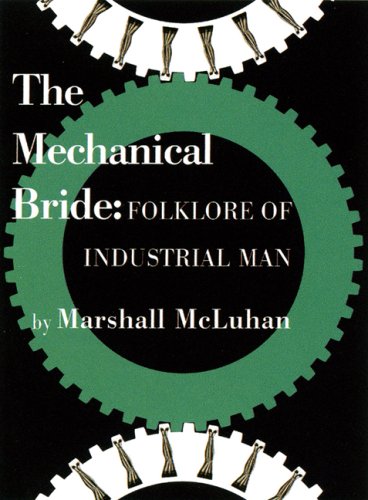
The Mechanical Bride
Few students ever acquire skill in analysis of newspapers. Fewer have any ability to discuss a movie intelligently. To be articulate and discriminating about ordinary affairs and information is the mark of an educated man. It's misleading to suppose there's any basic difference between education and entertainment. This distinction merely relieves people of the responsibility of looking into the matter. It's like setting up a distinction between didactic and lyric poetry on the ground that one teaches, the other pleases. However, it's always been true that whatever pleases teaches more effectively.


Marshall McLuhan, Classroom Without Walls,
Explorations in Communication, 1960

Wednesday, January 19, 2011

The End of Nature

A Beehive of Satellites
The information environment and effects created by the computer are as inaccessible to literate vision as the external world is to the blind. For example, the computer has made possible our satellites which have put a man-made environment around the planet, ending "nature" in the older sense. The new information technology will shortly encompass the entire astral system, harnessing its resources for terrestrial use. The important thing is to realize that electric information systems are live environments in the full organic sense. They alter our feelings and our sensibilities, especially when they are not attended to.


Marshall McLuhan, War and Peace in the Global Village, 1968

Tuesday, January 18, 2011

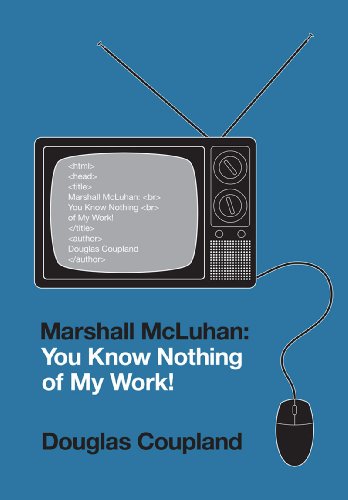
You Know Nothing of My Work!

Check out this excerpt from Nicholas Carr's review of You Know Nothing of My Work!, Douglas Coupland's new biography of McLuhan:


Neither his fans nor his foes saw him clearly. The central fact of McLuhan's life, as Coupland makes clear, was his conversion, at the age of twenty-five, to Catholicism, and his subsequent devotion to the religion’s rituals and tenets. Though he never discussed it, his faith forms the moral and intellectual backdrop to all his mature work. What lay in store, McLuhan believed, was the timelessness of eternity. The earthly conceptions of past, present, and future were, by comparison, of little consequence. His role as a thinker was not to celebrate or denigrate the world but simply to understand it, to recognize the patterns that would unlock history’s secrets and thus provide hints of God’s design. His job was not dissimilar, as he saw it, from that of the artist.


Click here for the rest of Carr's article
and here to buy the book on Amazon.

Monday, January 10, 2011

Discarnate Man and Natural Law

On the telephone, or on the air, man is in every sense discarnate, existing as an abstract image, a figure without a body. The Cheshire cat in Alice in Wonderland  is a kind of parallel to our state. When discarnate, man has no identity, and is not subject to natural law. In fact he has no basis for morals of any sort. As electric information moved at the speed of light, man is a nobody. When deprived of his identity, man becomes violent in divers ways. Violence is the quest for identity. In Canada there is pending a large body of nihilistic legislation dedicated to the ideal of freedom. No-fault divorce is being succeeded by no-fault murder!


Letter to Clare Boothe Luce, April 5, 1979, Letters of Marshall McLuhan

Friday, January 7, 2011

The Medium is the Message: Exercise in Gestalt Psychology

If you speak of the car as a medium, you are no further ahead because the car is no more than a figure detaching itself from a service environment of expressways, oil companies, automobile assembly lines, etc. The real medium, in the case of the car, is the totality of services it creates, or, better yet, the huge change that it creates in the human community. The car as the figure is not the message.


For North Americans, the hidden ground, the real message, of the car is what it does with our sense of privacy. The effect is different in Europe, but the car for us has been largely created to insure our privacy; in other words, the car's message is privacy, intimacy, and solitude. Privacy is made possible by the large network of highways, the biggest architectural structure in the history of the world which, by contrast, makes the pyramids and the Great Wall of China seem small. The car itself is no more than a figure in this service environment.


Marshall McLuhan, The Medium and the Light, Second Conversation with Pierre Babin, 1977